AULABIERTA
Aulabierta is a experimental structure aiming at developing a self-managed learning community within the University of Granada and . The participants are willing to get more actively involved in their own learning and to work collectively. Aulabierta defends the idea of knowledge acquisition in a rhizomatic and interdisciplinary way, and of the injection of atypical practices in the university.
A characteristic project of Aulabierta is the self-construction of the physical centre of the structure. For this project, for example, Aulabierta can provide official academic credits for students' participation in its activities.
To guarantee that the structure is not becoming a hierarchical one, special attention is paid to alternating the people managing the different projects. Many decisions are taken in assembly.
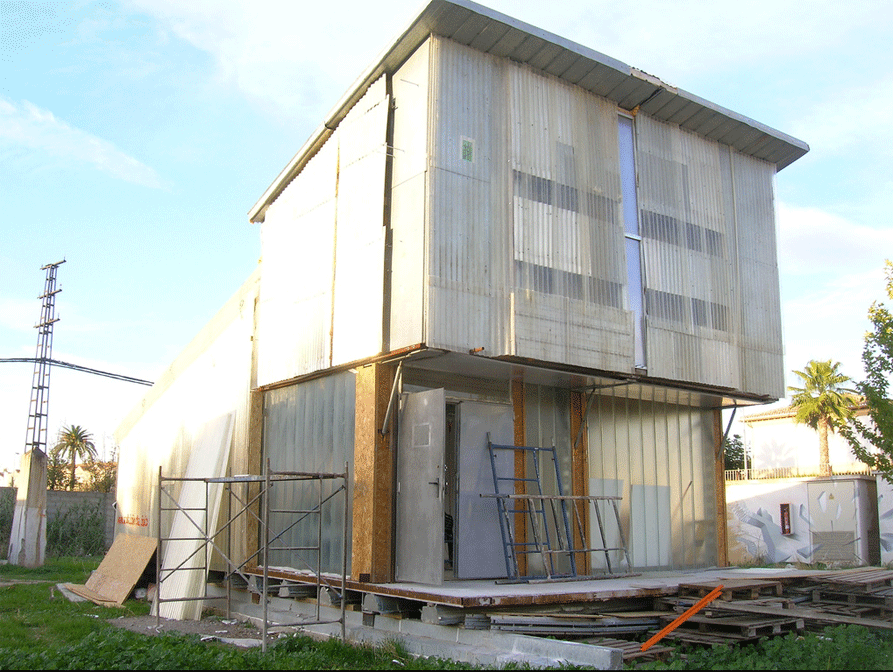 Aulabierta (2009) Construction of the structure [Online image]. Available at: <https://www.flickr.com/photos/aulabierta/1705366154/in/photostream/> [Accessed 29 April 2014].
Campos Fernández, José Daniel & Pérez Becerrra (2008–2009) Aulabierta. Learning Tactics. In: ACVic. Centre d'Arts Contemporànie (2009) Reversible Actions. Art, education, territory. Barcelona:. ACVic. Centre d'Arts Contemporànie. pp.118–124.
http://aulabierta.info
http://transductores.net/?q=es/content/aulabierta-granada-aulagarden
JOSEPH BEUYS' FREE INTERNATIONAL UNIVERSITY
In 1973, Beuys, in reaction to his recent dismissal from the Düsseldorf Academy where he refused the numerus clausus rule for his class, and writer Heinrich Böll wrote a manifesto for a Free International University for Creativity and Interdisciplinary Research, a centre for creative and democratic studies. The university is designed to foster recognition of everyone’s potential for creativity. One of the high points of the Free International University is its participation in documenta 6 in Kassel in 1977. The position of Beuys as a teacher opened a rich debate as the strong heroic dimension of his persona is hard to reconcile with his will for democratic teaching.
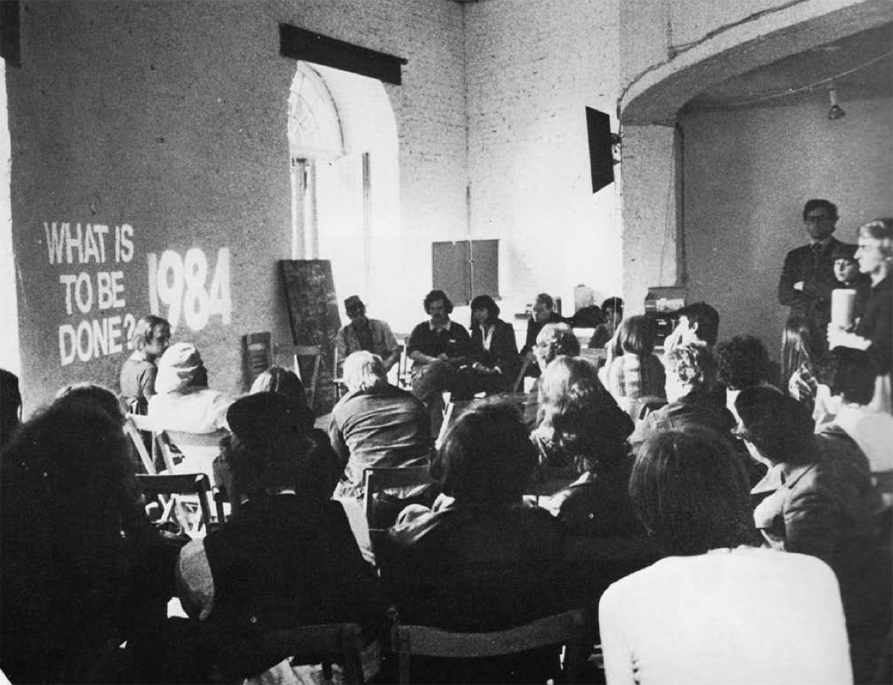 Beuys, Joseph, Free International University, documenta 6, 1977 (Tisdall, 1979: 282).
Beuys, Joseph in conversation with Willoughby Sharp (1969). Artforum, no.4, p.44.
Beuys, Joseph (2004) Not Just a Few Are Called But Everyone (Interview with Georg Jappe). Translated from German by John Wheelwright. In: Charles Harrison & Paul Wood eds. Art in Theory 1900–2000: An Anthology of Changing Ideas. Oxford: Blackwell. pp. 903–906. (Original work 1972).
Lee Podesva, K. (2007) A Pedagogical Turn: Brief Notes on Education as Art. Fillip. no.6, Summer, and Buchloh: Buchloh, B. (1980) Beuys: The Twilight of the Idol. Artforum. vol.5, no.18, January, pp.35–43.
Tisdall, Caroline(1979) Joseph Beuys. London: Thames and Hudson. New York: The Solomon R. Guggenheim Museum.
CENTER FOR POSSIBLE STUDIES
Since 2008 (following other projects in the neigbourhood by the Serpentine), the Center for Possible Studies is a project held by the Serpentine Gallery in London in a space located in the popular multicultural neighbourhood of Edgware Road, close to the Gallery.
The Center is putting into contact local people and artists, with the idea of reorienting certain existing practices in the direction of what the neigbourhood inhbitants and users are willing to do. Many reasearches and concrete projects have been realized in the neighbourhood during the last six years, through a series of residencies, commissions, and exhibitions.
The projects of the Center are both celebrating the history and experiences of the many cultures of the neighbourhood and providing a space to think about the future of the place.
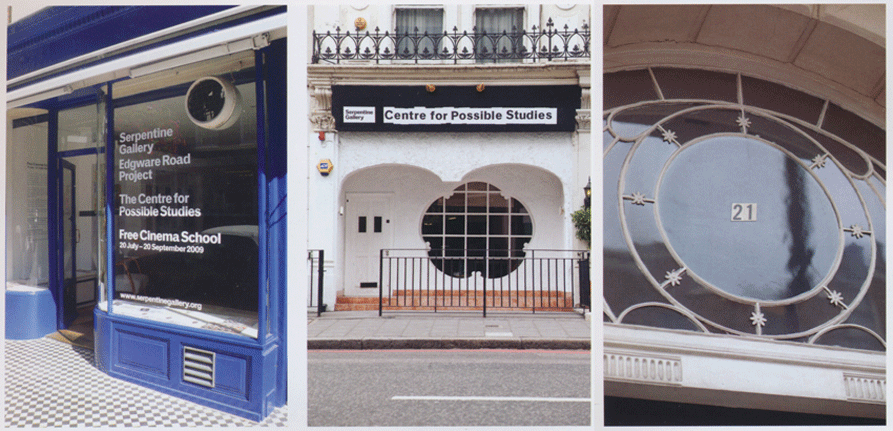 Centre for Possible Studies, three successive locations in the Edgware Road neighbourhood since 2008. (Serpentine Gallery and the Centre for Possible Studies, 2012: 20).
Serpentine Gallery and the Centre for Possible Studies (2012) On the Edgware Road. London: Koenig Books.
http://centreforpossiblestudies.wordpress.com
COPENHAGEN FREE UNIVERSITY
The Copenhagen Free University was opened in 2001 by artists Henriette Heise and Jakob Jakobsen, in part of their apartment. This self-teaching institution, which rapidly attracted several students and researchers, dedicated its efforts to producing critical consciousness and poetic language, and refusing to address education as part of 'the economy of knowledge' or to reproduce society’s power structures. The university proposed a working counter-model and tried to promote the make-up and the networking of other structures of that kind.
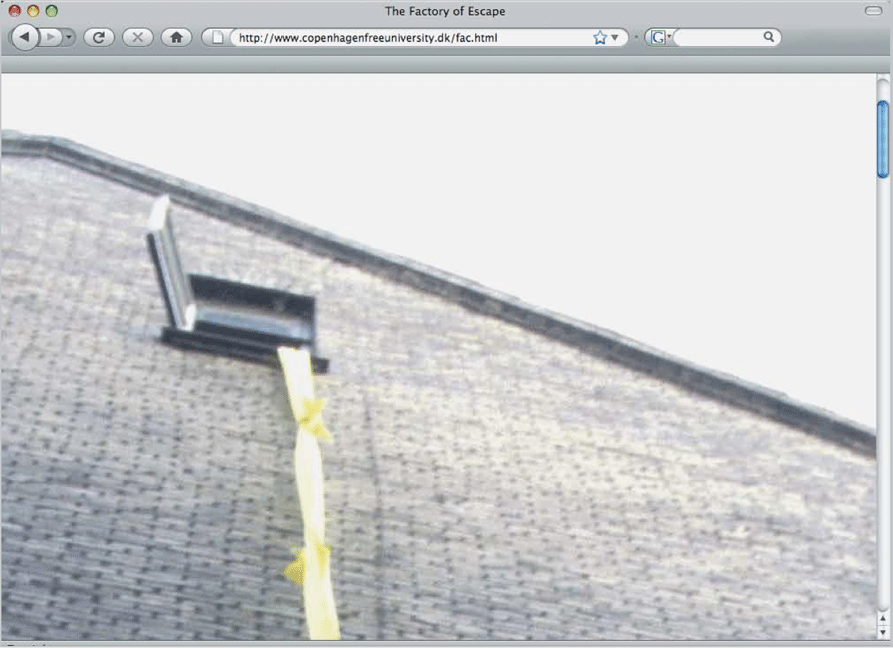 Copenhagen Free University (2002) Factory of Escape [caption of an online moving image].
Available at: <http://www.copenhagenfreeuniversity.dk/fac.html>[Accessed 29 April 2014].
The Free U Resistance Committee (2011) All power to the free universities of the future! The Copenhagen Free University website [Internet]. Available from: <http://www.copenhagenfreeuniversity.dk/future.html> [Accessed 29 April 2014].
http://www.copenhagenfreeuniversity.dk
FEMINIST ART PROGRAM
Created in 1970, the Feminist Art Program is a militant feminist teaching programme which was run by artists. Set up by Judy Chicago as a workshop at the Cal State University in Fresno, it moved in 1971 to the California Institute of the Arts in Los Angeles, where Judy Chicago worked with Miriam Schapiro. In it various guises, the programme existed until 1975. The programme created the means to question the existing educational system and provided women with access to an education created by and for them. In a women-only setting offering female artistic references and role models, the Feminist Art Program challenged the master–pupil relationship in favour of setting a higher value on personal narrative within a community of learners.
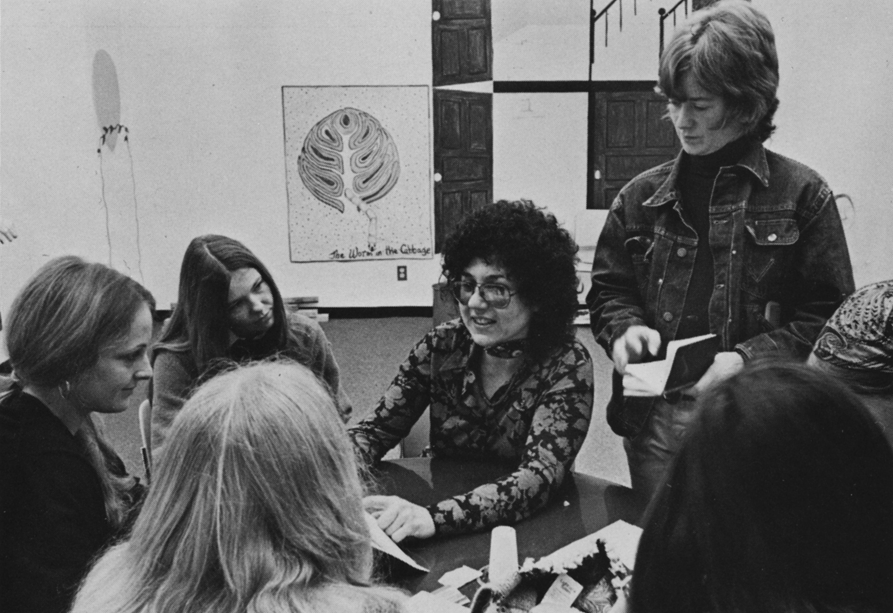 Feminist Art Program Workshop with Judy Chicago, 1973 (Wilding, 1977: 32).
Chicago, Judy (1975) Through the Flower. My Struggle as a Woman Artist. Garden City New York: Doubleday Books.
Meyer, Laura & Wilding, Faith (2010) Collaboration and Conflict in the Fresno Feminist Art Program in the 1970s: An Experiment in Feminist Pedagogy. n.paradoxa. vol.26, July, pp.40–51.
Shapiro, Miriam, (1972) The Education of Women as Artists: Project Womanhouse. Art Journal. vol.31, no.3, Spring, pp. 268–270. Reprinted in: Allen, Felicity ed. (2011) Education, Documents of Contemporary Art. Whitechapel, Cambridge: The MIT Press.
Wilding, Faith (1977) By Our Own Hands: The Woman Artist's Movement, Southern California, 1970–1976. Santa Monica: Double X.
Wilding, Faith (2009) Don’t Tell Anyone We Did It! [Internet]. Available from: <http://www.faithwilding.refugia.net/donttell.pdf> [Accessed 25 June 2011].
FREE/SLOW UNIVERSITY OF WARSAW
In 2009, the Free/Slow University of Warsaw began its activities. In Polish, the word Wolny (as in Wolny Univwersytet Warszawy) means simultaneously 'free' and 'slow'. The use of this term shows a strong interest in developing a knowledge exchange structure outside of the current orientation of the higher education system, against the search for profitability and cost efficiency.
The university organizes meetings with artists, seminars round socio-economic and political questions, and a reading group (which led, for example, to a Polish translation of Illich's Deschooling Society).
The Free/Slow University of Warsaw is nomadic and runs its activities in several venues in Poland and abroad.
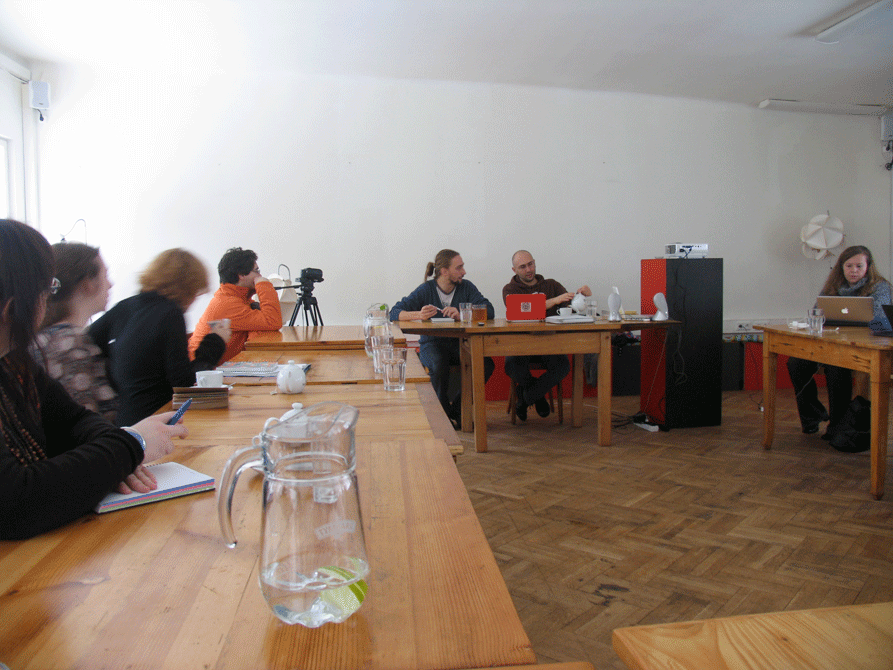 Free Slow University of Warsaw (2010) Summit. The Author, 2010.
Free/Slow University of Warsaw (2010) Creative Industries and Knowledge Factories: Analysis and Resistance. Readings for Artworkers. Vol.2. Free/Slow University of Warsaw [Internet]. Available from:
<http://wuw-warsaw.pl/raport2010.php?lang=eng> [Accessed 29 April 2014].
Free/Slow University of Warsaw ([undated]) Free/Slow University of Warsaw. Free/Slow University of Warsaw website [Internet]. Available from: <http://www.wuw-warsaw.pl/wuw.php?lang=eng> [Accessed 29 April 2014].
JEF GEYS
Jef Geys is a Belgian artist who worked in a nursery school in Balen, a small suburb of Antwerp. From the 1960s to 1989 he took advantage of his position as a teacher there to develop a pedagogical activity which he considers as a laboratory for possible forms of learning and exchanging knowledge. In the 1960s he worked, for example, on a mapping of the possible types of learning. He sees his work on a local level as a possibly addressing more universal questions.
With the participation of his immediate community, he develops collective creations. The project '!Women’s Questions?', for example, started when he hung a series of socio-political questions on the walls of his classroom (a school exclusively for girls at the time), questions that generated dialogue among his students. He presented this series of questions in different art exhibitions, as part of his artistic practice.
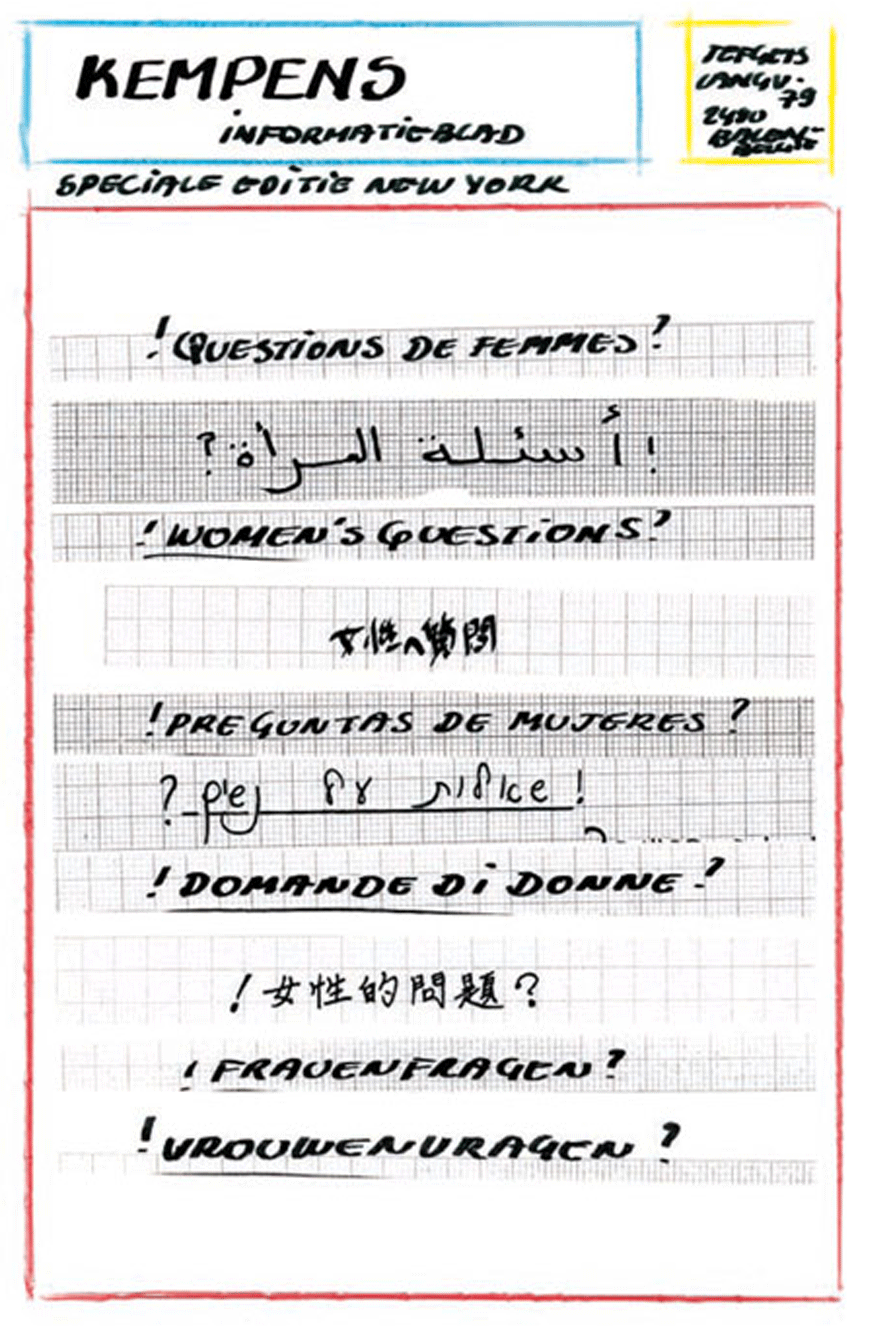 Geys, Jef (2008) !Question de femmes? Invitation to the exhibition Retrospectieve-Intropectie Room 3. Luxembourg: Erna Hecey Gallery.
NILS NORMAN'S EXPLODING SCHOOL
In connection with the various contexts in which he has taught, Nils Norman has created, since 2002, an Exploding School. Each teaching situation gives rise to a different project, conceptualized and developed together with students. Taking inspiration from the book Streetwork by Colin Ward and Anthony Fyson, the school is nomadic and uses the city as its classroom. It studies new artistic strategies in public spaces, the gentrification of towns, city planning and projects that favour a social dimension.
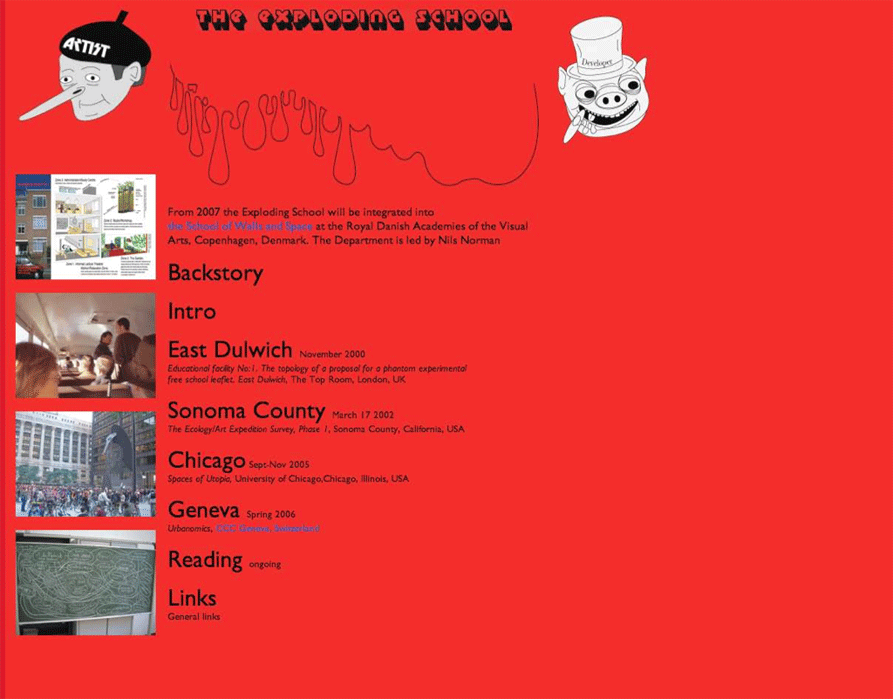 Norman, Nils (2002-2007) The Exploding School [online image]. Formerly available at: <http://www.dismalgarden.org> [Accessed 20 December 2009].
Asdam, Knut [undated] An interview with Nils Norman. What happened to our housing? –We sold it! What happened to our park? –We bought it! Society of Control [Internet]. Available from: <http://www.societyofcontrol.com/x404/uks/> [Accessed 29 April 2014].
Ward, Colin & Fyson, Anthony (1973) Streetwork: The Exploding School. London: Routledge & Kegan Paul Books.
ODA PROJESI
Oda Projesi (Turkish for ‘space’ and ‘project’) is an artists’ collective which, between 1997 and 2006, used a three-room apartment in Galata, then a working-class district of Istanbul, as a base for its projects. The collective organized workshops and events, sometimes with invited artists, together with the residents of the neighbourhood, especially children. The apartment was not only the place where the collective’s projects came to life, but was also a space that the local residents could use to meet, play or hold celebrations in. For the artists, the aim of the activities was not to change society, but simply to exchange experiences (Oda Projesi uses the slogan 'exchange not change'). If the structure definitely lets its users use their decision power to organize their own activities, it risks losing its artistic character in becoming a traditional community room.
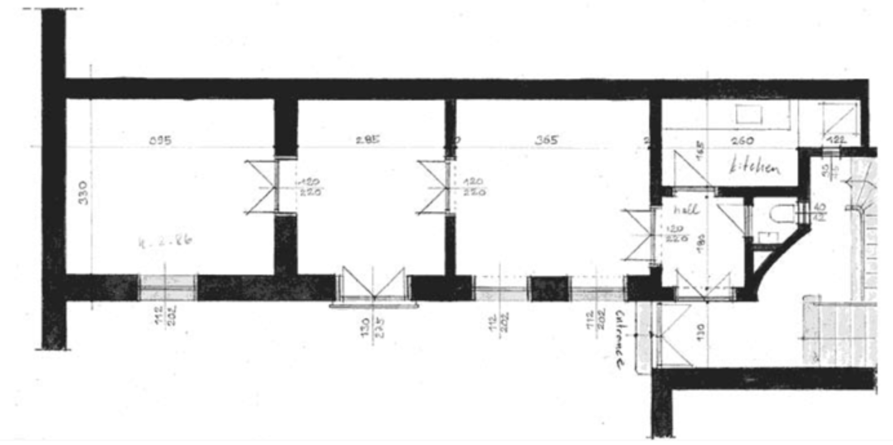 Oda Projesi. Map of the flat rented by the collective in the Galata neighbourhood, Istanbul (Özkan, 2011: 68).
Özkan, Derya (2011) Spatial practices of Oda Projesi and the production of space in Istanbul. OnCurating.org (public issues) [Internet], n°11. Available from: <www.oncurating.org/index.php/issue-11.html> [Accessed 29 April 2014].
http://odaprojesi.blogspot.ch
TIM ROLLINS + K.O.S.
At the beginning of the 1980s, Tim Rollins was teaching art in an after-school class in the South Bronx, New York City, to children who had dropped out of the state school system. Rollins took a radical decision: to merge artistic work and teaching in one and the same activity.With a group of students aged 16–19, Rollins set up the Art and Knowledge Workshop; the participants began producing collective art works, which they sign jointly 'KOS' (for 'Kids Of Survival') with Rollins. The group defined its work as an act of resistance to a system that marginalizes them. Rollins developed a somewhat authoritarian position in order to make the collaboration possible, and defends the idea of selling the works on the art market, not only to finance the workshop but also for the work of the participants to be socially recognized.
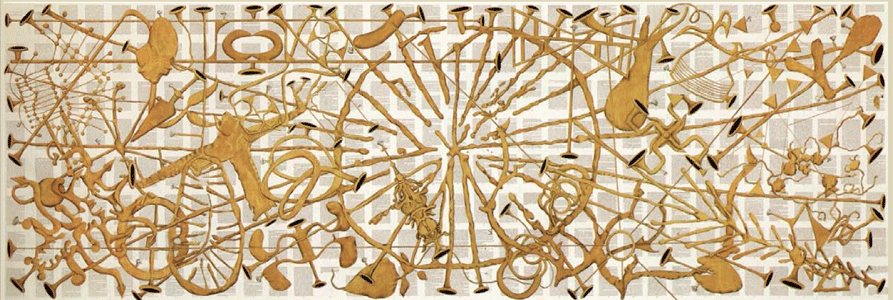 Tim Rollins + K.O.S. (1987–1988) Amerika: For Thoreau, Paint on book pages on canvas, 180 x 530cm (Garrels, 1989–1990, p.33).
Garrels, Gary ed. (1989) Amerika Tim Rollins + K.O.S. New York: Dia Art Foundation.
Wallace, Michele (1989–1990) Tim Rollins + K.O.S.: The ‘Amerika Series’. In: Dia Art Foundation Amerika Tim Rollins + K.O.S. New York: Dia Art Foundation.
STOCKYARD INSTITUTE / PEDAGOGICAL FACTORY
The Stockyard Institute is an artistic organization that has been based in Chicago since 1995. It takes an experimental approach to education and teaching via contemporary art. Its works are conceived according to a democratic process, open dialogue and the commitment of each individual to everybody else in the group, while each project concentrates on issues that are relevant to life in the city. The project 'Pedagogical Factory: Exploring Strategies for an Educated City' took place for three months in 2007 in Chicago Hyde Park Art Center, and a temporary, public laboratory was created to implement experimental ideas and processes at the frontier between art and teaching. It developed a very interesting position toward the official school system, seeing the possibility for artists to experiment in the freedom of situations outside of schools, in order to open, later, a dialogue with schools and to see how to improve education 'for everybody', through the official school system.
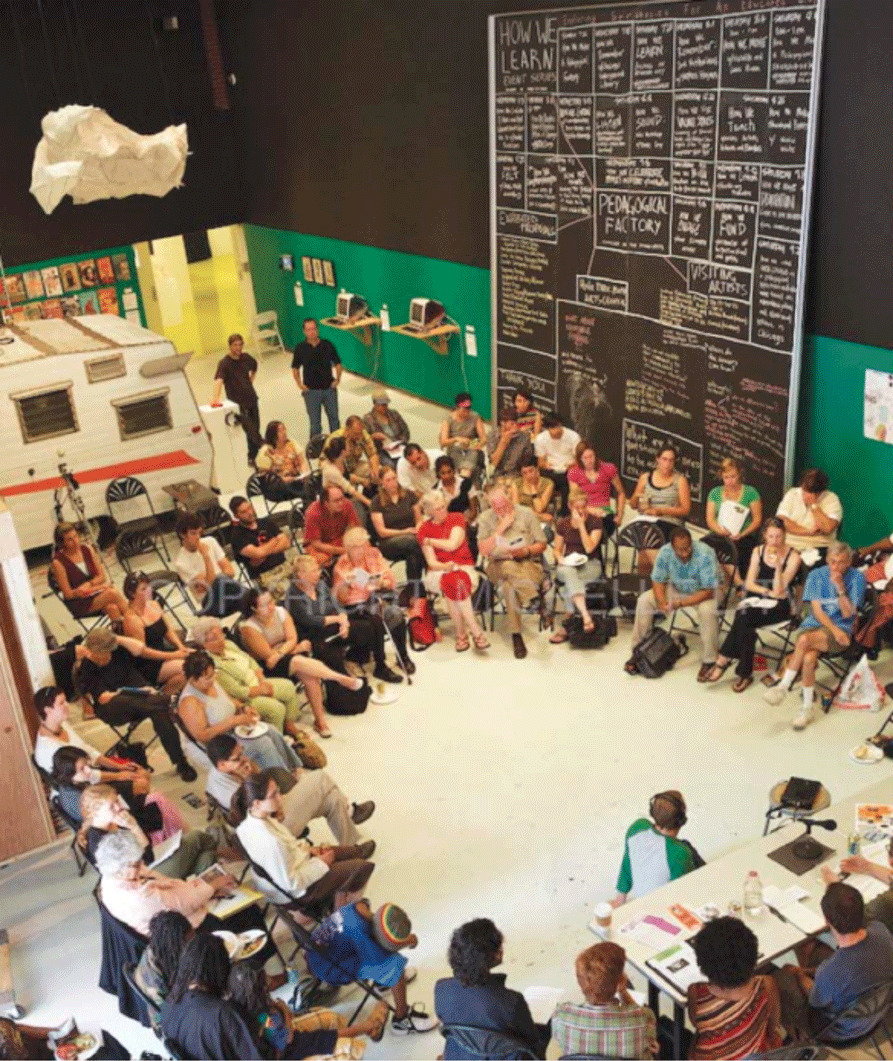 View of one of the events of the exhibition Pedagogical Factory, Hyde Park Center (HPAC), Chicago, 2007. (Stabler, Bert (2008) Death to Law: Progressive Public Art in Chicago. Proximity magazine [Internet], n°1. Available from <http://proximitymagazine.com/2008/12/death-to-law/> [Accessed 29 April 2014].)
http://www.stockyardinstitute.org
http://www.stockyardinstitute.org/pedagogical-factory-2007/
http://areachicago.org/5-how-we-learn/
TRANSDUCTORES COLLECTIVE PEDAGOGIES AND SPATIAL POLITICS
Transductores is a cultural project that took place in the Centro José Guerrero de la Diputación of Granada in 2010. It aimed at showing how disciplines that are traditionally practised in separated institutions (such as art, education and social work) can be rethought in a more interconnected way.
The project was conceived as a way to develop long projects that could have a long–term impact on the different people and institutions involved: the José Guerrero art centre, educational centres, Aulabierta, the university, the students, teachers.
Transductores was organized around three main strands: a series of seminars and workshops, an exhibition thought as archives of experiences with collective pedagogy and spatial politics, and finally a web structure imagined as a way to multiply and continue the different projects.
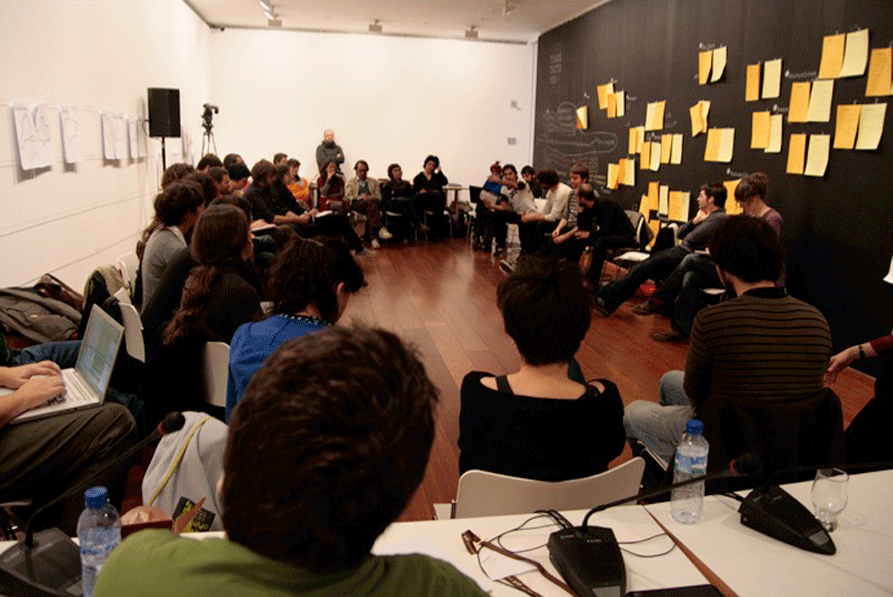 Meetings in the exhibition Transductores (Centro José Guerrero de la Diputación de Granada, 2010). Javier Rodrigo, material for his presentation in the Utopia and the Everyday round-table, Centre d’art contemporain Genève, 26 March 2010.
Rodrigo, Javier & Collados, Antonio (2010) 'English info TRANSDUCERS: Collective Pedagogies and Spatial Politics' [Internet]. Available from: <http://transductores.net/?q=es/content/english-info-transducers-collective-pedagogies-and-spatial-politics> [Accessed 29 April 2014].